Essential Services and Battery Reserve on a Boat
Identify essential boat electrical loads, set a usable lithium battery reserve and plan what remains powered after inverter or BMS shutdown.
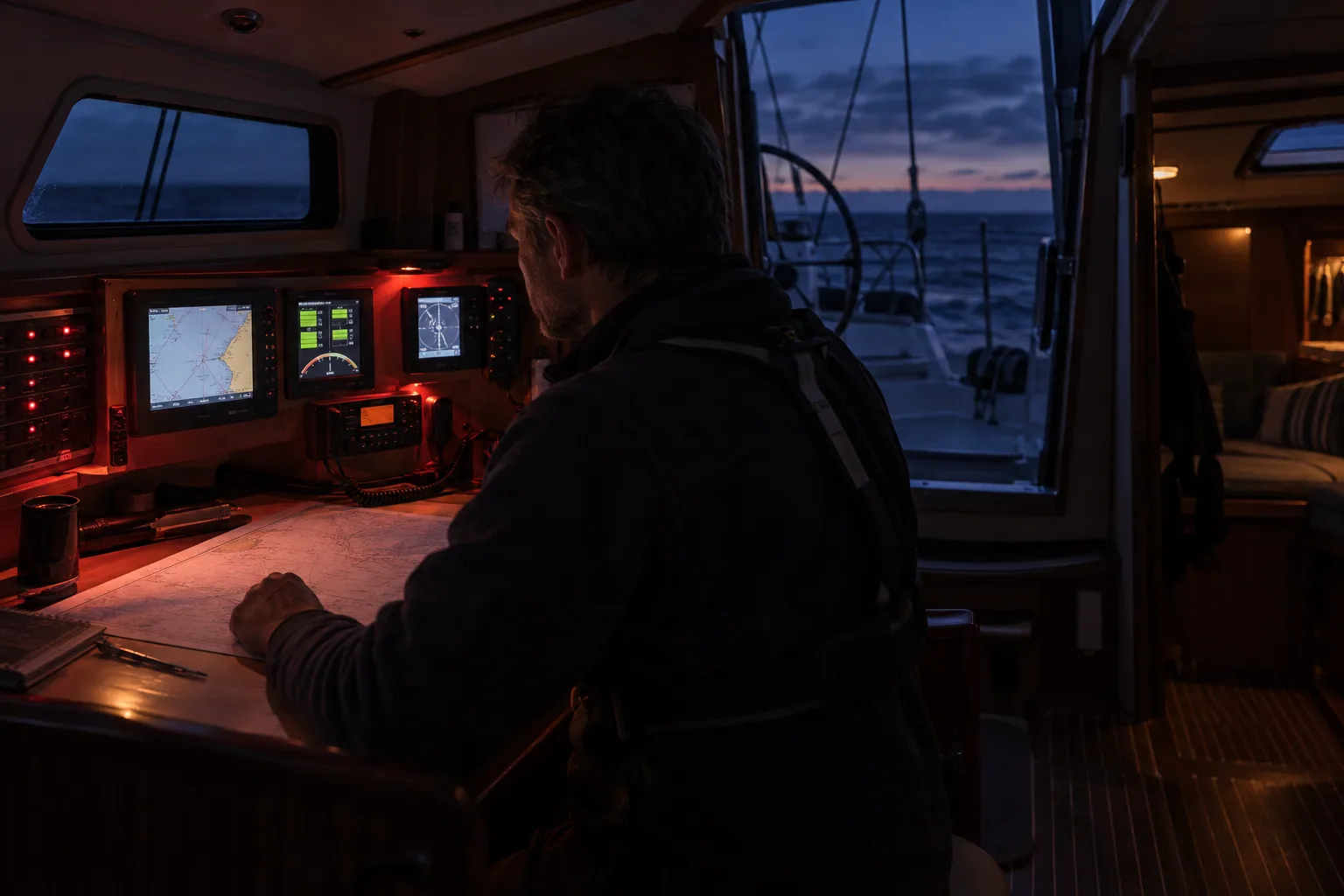
Battery reserve is not merely a percentage left on a display. It is an operating agreement: which functions the vessel must preserve, for how long, after charging underperforms or part of the electrical system becomes unavailable.
A reserve that exists only inside the same battery, BMS, busbar or inverter that caused the failure may not be accessible. The design therefore needs both an energy calculation and a failure-path review.
Define essential loads for this vessel
Start with the vessel’s operation rather than a universal list. A day boat inside sheltered water, an offshore monohull, a power catamaran and a commercial fishing vessel have different consequences when equipment stops.
Common candidates include navigation lights, VHF, AIS, bilge pumping, essential instruments, engine controls, steering support, position reporting and limited emergency lighting. Some boats also depend on electric fuel transfer, ventilation, communications or refrigeration for medicines.
Record the watts, expected duty cycle and minimum operating hours for each essential load. Confirm whether a quoted wattage represents normal use, transmit power, pump start-up or a peak that lasts only seconds.
Separate comfort, mission and survival loads
Classifying loads makes load shedding understandable under pressure:
- Survival and immediate safety: equipment needed to keep people safe and communicate.
- Vessel operation: systems needed to navigate, manoeuvre or protect the boat.
- Mission loads: equipment needed for the trip or commercial task but not immediate safety.
- Comfort loads: cooking, entertainment, air conditioning and conveniences that can be removed first.
This order should be visible in the distribution design and the owner guide. If every circuit is fed through the inverter, switching off comfort loads may be harder than expected.
Calculate the energy reserve
For each essential load, multiply watts by required hours, add the results, then allow for DC conversion or inverter losses where applicable. Use measured duty cycles when possible.
For example, a group of essential loads averaging 85 W for 12 hours requires about 1.02 kWh before conversion losses and contingency. At 12.8 V that energy is roughly 80 Ah; at 25.6 V it is roughly 40 Ah. The stored energy is the same even though the amp-hour figure changes.
Use the battery runtime calculator to test a combined load and the daily power-use guide to keep the emergency reserve separate from the normal cruising budget.
Set warning and load-shedding stages
One low-state-of-charge alarm is rarely enough. A practical plan can provide an early warning, a point where comfort loads are removed, a second point where mission loads are reviewed, and a final protected reserve for essential services.
State of charge from a shunt can drift if it is not configured and synchronised correctly. Reserve decisions should also consider battery voltage under load, BMS alarms, recent charging performance and the reliability of the monitor.
Test failure paths, not only capacity
Ask what happens if the BMS opens, the main fuse operates, the inverter fails, the shunt loses power or the house-bank isolator must be opened. Identify which essential services disappear together.
The answer may involve a separately protected essential-services bus, a dedicated communications supply, a retained start battery or a documented emergency connection. It should not involve bypassing the BMS or fitting temporary wires during an emergency.
Review the reserve before demanding passages
Recalculate after adding Starlink, refrigeration, autopilot, electric cooking or other significant loads. Before an offshore passage, compare the reserve with forecast charging, night-time navigation demand and the consequence of losing the strongest charging source.
Available energy is a safety input, not a promise. DNV’s maritime battery work emphasises that safe operation depends on being able to estimate and predict available stored energy. For recreational boats, the practical version is simple: measure, preserve a margin and design so the reserve can still reach the loads it is intended to protect.
- WPowerWhat runs together?
- hTimeHow long each day?
- WhEnergyPower × time
- %ReserveWeather and essentials
- AhCapacityAt system voltage